11 September 2026
Open the interactive wind study. It shows the saved nominal 10 m horizontal winds from three full-day research calculations for 1 June 2023. Switch model settings, advance through the day, or inspect a place or map cell. These are dated, unvalidated wind diagnostics; colours represent wind speed in m/s.
The same scale and sampling rules apply throughout the study area. The default view covers the original 20.2 × 20.2 km grid; “Show surrounding area” reveals the full 40.2 × 40.2 km calculation. The original square is a study boundary, not a limit on a real plume. Place labels identify reference locations, not neighbourhood-average conditions or complete exposure-receptor coverage. The separately marked flare location comes from the dated 2024 plan.
These wind fields help inspect transport assumptions. They do not show pollutant concentrations, plume rise, inversion depth or health-risk zones. The existing illustrative plume explorer remains available separately. The whole-area wind comparison, airport observation check and low-level processing trace describe the calculations and their performance.
The download contains 3 settings × 24 times × 2 wind components × 201 × 201 cells: 5,817,744 values, 11,635,488 bytes before network compression. Each component is rounded to 0.01 m/s for this display, with a maximum component error of 0.005 m/s, apart from floating-point rounding. Original model outputs remain unchanged. This display precision does not describe model uncertainty.
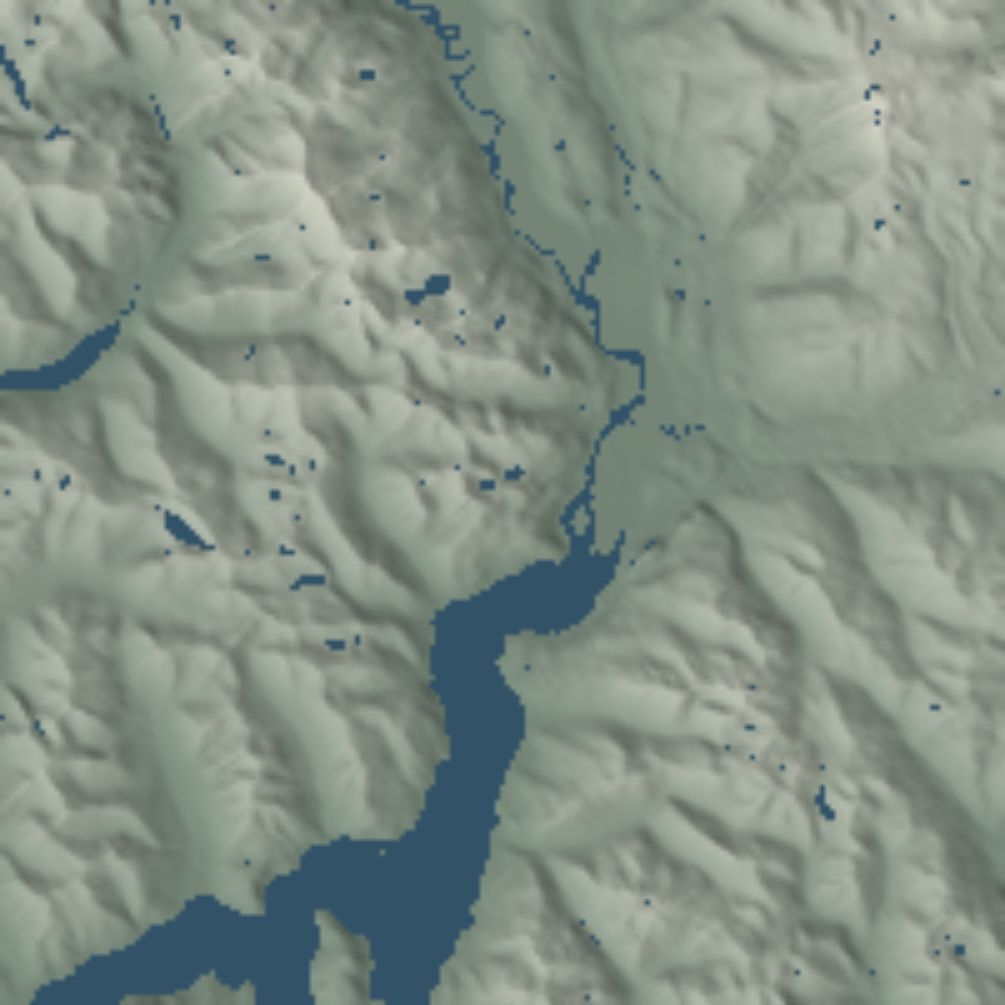
The three files are metadata, packed wind values and model terrain image. The metadata gives source-output hashes, timestamps, projection, grid edges, ordering, scale, reference locations and observations. The binary is little-endian signed 16-bit integers in case, time, component, south-to-north row, west-to-east column order, multiplied by 0.01 m/s. Components are the saved U and V values; grid origin is the southwest edge, not the first cell centre.
Download the display checks and preparation and independent-review methods. These checks test faithful presentation of the retained calculations. Physical evaluation of local winds, release inputs and vertical transport remains part of the research programme.